Lithium in Chile: the world's largest reserves and third place in production
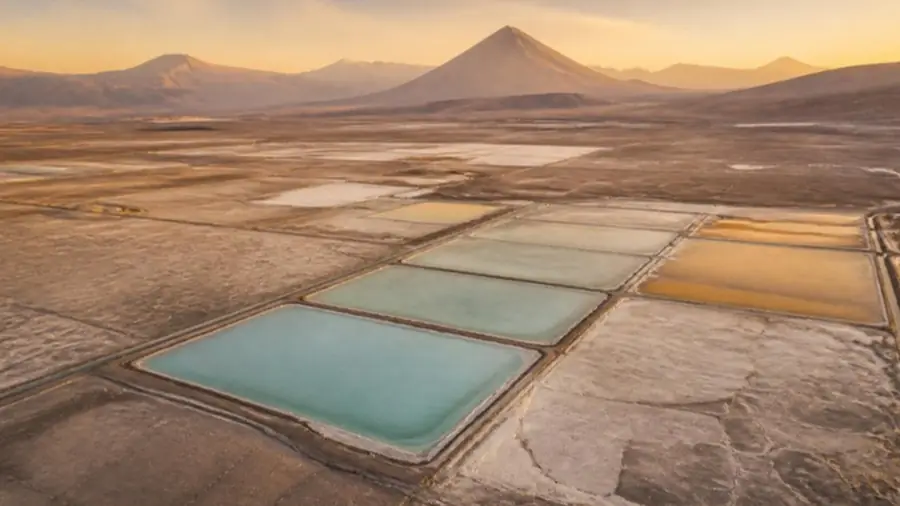
Chile holds the largest share of the world's lithium reserves and has, at the same time, fallen from first to third producer. Both facts have the same explanation: the access regime. Understanding how you get in is more useful than watching the price.
On this page
- Lithium is not concessible, and that is not a detail
- What Chile exports today does not come from a CEOL
- No CEOL is producing, and five came back from the Comptroller
- The Salar de Atacama is already settled to 2060
- The protected salt flats network is not in force
- The numbers, and what they say
- What is decided first
Lithium is not concessible, and that is not a detail
The Constitution grants the State «absolute, exclusive, inalienable and imprescriptible ownership of all mines», and the text expressly mentions salt flats. On that basis, Decree Law 2,886 of 1979 reserved lithium to the State «because the national interest so requires», and both Law 18,097 and article 7 of the Mining Code declare it not susceptible to mining concession, «without prejudice to mining concessions validly constituted beforehand».
That last clause is what orders the entire Chilean market, and we return to it in the next section.
From this follow three routes, and only three, to exploit lithium in Chile:
| Route | How it works |
|---|---|
| Directly by the State or its companies | Codelco and ENAMI, which then seek private partners |
| Administrative concessions | Provided for in the Constitution, with no significant use |
| Special Lithium Operation Contract (CEOL) | Signed by the Minister of Mining, on a favourable report from the Cochilco Council, on terms the President sets case by case by supreme decree |
The practical consequence, and the one foreign investors find hardest to accept: there is no regulated process to enter and win on merit. The Comptroller General and the Constitutional Court have confirmed that it falls to the State to decide how and with whom it develops the activity. Access is negotiated; it is not awarded.
What Chile exports today does not come from a CEOL
This is the point almost no analysis makes explicit. Chilean lithium production comes from the Salar de Atacama, over mining claims that CORFO constituted in 1977, before the declaration of non-concessibility. They are exploited under lease contracts between CORFO and the operators, not under CEOLs.
Put another way: the regime that defines Chile's current supply is a historical exception, and the regime that defines everything new has yet to produce a single tonne. Conflating the two leads to reading the Chilean market as open in a way it is not.
No CEOL is producing, and five came back from the Comptroller
The contracts granted point to production towards the end of the decade. The Salares Altoandinos CEOL, ENAMI with Rio Tinto, obtained final clearance from the Comptroller General in February 2026 and runs to 2060. The Maricunga CEOL, held by Codelco's subsidiary, was updated by decree published in January 2026 to widen the area and extend the exploration phase. In September 2026 the first CEOL signed with a private company was executed: Quiborax, in Arica, for the reprocessing of lithium contained in the discard tailings of its boric acid production.
That last case deserves attention: the first contract with a private party is not a new salt flat, it is already-extracted material. For anyone seeking entry, reprocessing legacy material may be a shorter route than a virgin salt flat.
The Salar de Atacama is already settled to 2060
The decade's most significant transaction has closed. After obtaining competition clearances across multiple jurisdictions — including the Chinese regulator in November 2025 — and the Comptroller's clearance of the CORFO contracts in December 2025, the joint venture between Codelco and SQM was constituted on 27 December 2025 under the name Novandino Litio. Codelco holds the majority by the narrowest of margins, the board is split evenly, and the general management sits with SQM to 2030 and with Codelco from 2031 to 2060.
The figure an investor should note is a different one: the environmental qualification resolution under which the salt flat operates expires on 31 December 2030. Operating beyond that requires fresh environmental approval, and the project seeking it is already under assessment. Between 2026 and 2030, Chile's largest lithium asset has to renew its licence to exist.
For anyone arriving now the reading is direct: the Salar de Atacama is not the opportunity. It is allocated for two and a half decades. The opportunity, if there is one, lies in the other salt flats, in reprocessing, and downstream.
The protected salt flats network is not in force
In November 2025 the Council of Ministers for Sustainability approved the creation of six protected areas covering ten high-Andean salt flats and lagoons in Atacama, and the decrees were signed in January 2026. On 12 March 2026 the Ministry of the Environment withdrew them from the Comptroller General, along with thirty-seven other environmental decrees. Without the Comptroller's clearance a decree is not in force, and as of 29 July 2026 none of the six had been resubmitted.
This should not be read as an opening. It reads as uncertainty about the perimeter: a salt flat with no conservation category today may acquire one within the time it takes to process a project. And formal protection is not the only constraint: the northern salt flats are inhabited, and indigenous consultation has voided entire processes — the 2021 lithium tender terms were struck down by the Supreme Court on that ground.
We cover it in detail in our analysis of the lithium regime.
The numbers, and what they say
| Indicator | Position |
|---|---|
| Reserves | Chile holds around 25% of world reserves, the largest share of any country |
| Production | Third producer, behind Australia and China |
| World share | Fell from 26% in 2020 to 19.4% in 2025 |
| Processed lithium | First in the world: 46% of carbonate plus hydroxide exports, ahead of Argentina and China |
| Destinations | Asia takes 95%; China 67% and South Korea 22% |
The conclusion is not that Chile has fallen behind, but something more precise: it lost share in the resource and kept it in the processing. While Australia grew in spodumene concentrate, Chile continued to lead the chemical product. A project arriving today competes in a country with abundant reserves, closed access and installed processing capacity.
What is decided first
- Which access route is realistic? There is no tender to enter. The question is not how to win an award, but with whom the position gets built: a state partner, reprocessing of legacy material, or a pre-existing concession position.
- What concessions sit over the area, and whose are they? Simplified CEOL processes have required control of a high proportion of the mining concessions in the requested area. The position is built before applying, not after.
- What protection bears on the salt flat, and what might? Today that is an answer with a date on it.
- Who lives there? Indigenous consultation is not a late-stage formality: it has voided entire processes.
- Where does the water come from? Brine and freshwater are governed by different regimes and both are under strain. See desalination.
Our limit, stated
This analysis is generic and describes the access regime, the enabling titles and the regulatory risk of lithium in Chile. It is not a title study or a current ownership report, we do not estimate resources or reserves, we do not sign reports under NI 43-101, JORC or CH 20235, and it does not replace environmental assessment or anticipate its outcome.
Evaluating an entry into Chilean lithium?
Access is negotiated, not awarded, and the position is built before applying. A thirty-minute conversation is usually enough to see whether there is a realistic route.
Start a conversationSources: Political Constitution, art. 19 No. 24 · Decree Law 2,886 of 1979 · Law 18,097, Constitutional Organic Law on Mining Concessions · Mining Code, arts. 7 and 8 · recitals of the Ministry of Mining decrees granting CEOLs published in 2026 · Novandino Litio Annual Report 2025 and communications from Codelco and the Ministry of Economy on the regulatory clearances · Ministry of the Environment, approval of the salt flats network (November 2025) and tracking report on the decrees withdrawn from the Comptroller (FIMA, updated 29 July 2026) · Cochilco and SUBREI, 2025 production, share and export figures. Last reviewed: October 2026. General information, not legal advice.