Data centers in Chile: where they can go, and why that decides the permit
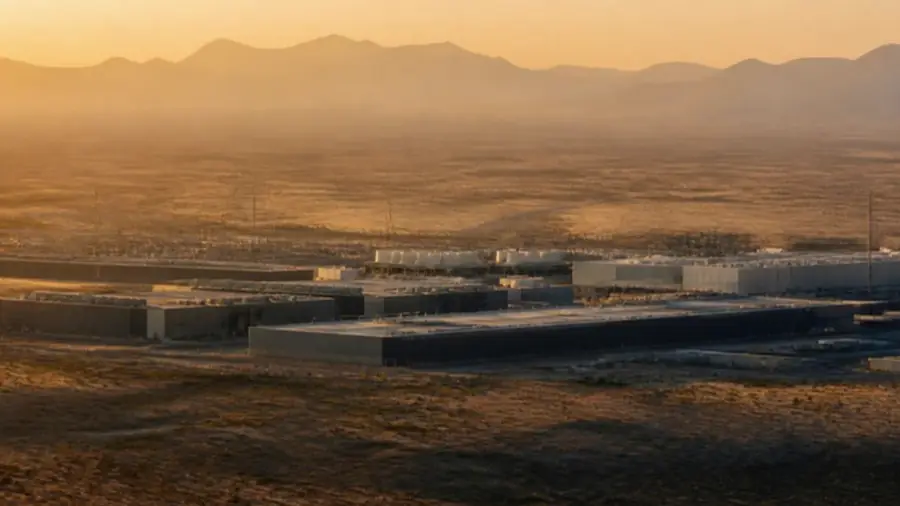
A data center in Chile is decided by three things that do not live in the same place: power, water and land. And by a fourth that almost nobody anticipates, because it does not work the same way in other jurisdictions: whether the project enters environmental assessment at all, and through which door.
On this page
A data center has no door of its own into the SEIA
This is the first thing to understand, and it is counterintuitive for anyone arriving from abroad. The Environmental Assessment Service says it plainly: data centers «do not have an express entry typology into the SEIA in Law 19,300 or in article 3 of DS 40, of 2012… entry into the system is not triggered automatically by their nature alone, but must be analysed case by case on the basis of the parts, works or actions associated with their execution».
The practical consequence: a project does not enter for being a data center. It enters through what hangs off it. The line that connects it, the generation that feeds it, the water that cools it, the fuel for its generators. Each has its own threshold, and crossing one is enough.
| What can make it enter | Threshold | Rule |
|---|---|---|
| The high-voltage line | Above 23 kV and at least 2 km | Art. 3 b.1) of the SEIA Regulation |
| On-site power generation | More than 3 MW | Art. 10 c) of Law 19,300 |
| Fuel storage | 1,000 tonnes or more | Art. 3 ñ.3) of the SEIA Regulation |
| Water use or abstraction | No threshold of its own; depends on the sectoral permit and the impact | Sectoral environmental permits 138, 155, 140 and 156 |
Two of those thresholds changed recently. Supreme Decree No. 17/2025 of the Ministry of the Environment, published in the Official Gazette on 21 January 2026, raised flammable-substance storage from 80 to 1,000 tonnes, and added to high-voltage lines a minimum length of 2 kilometres on top of the 23 kV. The stated basis, in the Ministry's own preliminary-draft file, is to harmonise with DS 43/2015, which allows storage of up to a thousand tonnes in a dedicated warehouse.
For a data center the effect is direct, because the diesel for the back-up generators was in practice what made it enter. With the threshold where it now stands, a project that stays below a thousand tonnes and resolves its connection in under two kilometres can file a pertinence query rather than an environmental impact declaration or study.
Water is the objection that has stopped projects
Not consumption in the abstract, but abstraction for cooling. One case set the standard, and it is worth knowing precisely, because it circulates told another way.
In February 2024 the Second Environmental Court partially annulled the environmental qualification resolution of a data center in Cerrillos, in the Metropolitan Region. The annulment was confined to the hydrological component: the court held that the absence of significant impacts on the Central Santiago Aquifer had not been adequately justified, and required the effects of climate change on the aquifer's future availability to be considered. It was not a rejection of the project, nor a revocation of the permit. Months later the holder chose not to redo the assessment: it relinquished the resolution and announced a redesign with air cooling.
The order of magnitude explains why water weighs so much. The Environmental Assessment Service itself records that a large-scale data center «can use between 1 and 3 million litres of water a day for cooling».
Chile has no binding standard or threshold for water consumption by data centers. The criterion the Service published in January 2026 is methodological: it guides how to assess, it does not set a performance standard. That leaves the discussion where it is most expensive to resolve — inside the assessment of each project.
Air cooling is now the usual route to mitigation, and the Cerrillos case made it the reference. But it does not make the problem disappear: it moves it. Less water means more electricity, and more back-up. The risk shifts from the water component to the energy component and the fuel — which is precisely where entry into the system is decided.
Nor does everything end in court. In April 2026 the same Second Environmental Court rejected a claim against an approved data center in Huechuraba and dismissed the argument that it had been split from its high-voltage line. A well-built project holds.
The north: what makes it attractive and what complicates it
The northern macrozone concentrates two things a data center needs: abundant renewable energy and available land, much of it state-owned. During 2026 the Ministry of National Assets has reported applications for concessions over state-owned land for data centers in process in the Antofagasta Region, and the state-owned company Desarrollo País opened a market consultation on the energy solution for an artificial-intelligence training campus in that same region.
Access to that land has a route of its own — the onerous use concession, with its terms and its condition of incorporating a Chilean company before signing — and we cover it in the chapter on siting, because it applies to any project and not only to this sector.
What almost nobody says out loud is that the regulator itself points in two directions at once. The Service's criterion notes that data centers for which low latency is not a critical factor «can be located, for example, in rural areas with large expanses of land, access to renewable energy and water availability, thereby reducing pressure on urban areas». And in the same document it recommends «avoiding locations in water-stressed areas».
Both sentences are correct, and they sit badly together in northern Chile, which offers exactly the land and the energy of the first and carries the problem of the second. That tension is not resolved by choosing a quote: it is resolved with a technical basis for the location, a cooling technology consistent with it, and a water source that does not depend on an aquifer under pressure. It is regulatory design work, and it is done before the land is bought or it is not done at all.
Going off-grid does not simplify the permit
A campus that generates its own power and does not connect to the electrical system looks, at first sight, like the simplest project to authorise. In part it is, and in the part that matters it is not.
What is simplified: in Chile, generating plants other than hydro do not require an electrical concession, and neither do distribution lines that are not public service. A self-sufficient campus does not need to ask the State for a title to generate or to distribute within its own boundaries.
What is not simplified: a data center's own generation is measured in tens of megawatts, and the SEIA entry threshold for a generating plant is 3 MW. The project that touches the least public infrastructure is the one that enters environmental assessment beyond argument. Going off-grid does not close the SEIA door: it swaps it for a wider one.
And there is a counterpart that tends to be discovered late. Having no concession also means not having the right to establish easements that a concession confers. While everything happens inside your own property, it makes no difference. The day a line, an aqueduct or a road has to cross someone else's land, it is negotiated on market terms, not imposed.
What is decided before the land is bought
Five questions, in this order, because each one conditions the next:
- Does the project require low latency? If it does, the universe of sites narrows to the vicinity of connectivity nodes and the discussion becomes urban. If it does not, the territory opens up and the analysis changes entirely.
- How is it cooled? It is the decision that most determines environmental risk and the hardest to change afterwards.
- Where does the water come from, and what else depends on that same source? An aquifer with other users is not the same problem as a dedicated source.
- Connected or off-grid, and with how much back-up? From this follow the fuel threshold, the length of the line and, with them, the permitting route.
- What layers of rights sit over the site? Mining concessions, water rights, indigenous land, protected areas and territorial planning are not verified with a single certificate.
The first four are design decisions. The fifth is a finding: it is either there or it is not, and it is worth knowing before capital is committed, which is the only moment at which the result can still change the decision.
Our limit, stated
This analysis is generic and identifies the regulatory framework and the layers of rights that condition a project's siting. It is not a title study or a current ownership report, it does not replace environmental assessment or anticipate its outcome, and it does not constitute advice on the design, engineering or operation of data centre infrastructure.
Evaluating a data center in Chile?
The permitting route is set in the design, not afterwards. A thirty-minute conversation is usually enough to establish which door your project would enter through.
Start a conversationSources: Environmental Assessment Service, «Criterio de Evaluación en el SEIA: Introducción a proyectos de data center», first edition, January 2026 · Supreme Decree No. 17/2025 of the Ministry of the Environment, published 21 January 2026, and the same Ministry's preliminary-draft file · Law No. 19,300, article 10 letter c) · DFL No. 4/2006, General Law of Electrical Services, articles 2 and 3 · Second Environmental Court, judgments in cases R-270-2020 and R-271-2020 (joined), and R-539-2025. The relinquishment of the environmental qualification resolution in Cerrillos, the applications for state-land concessions in Antofagasta and the Desarrollo País market consultation come from public press reporting. Last reviewed: October 2026. General information, not legal advice.